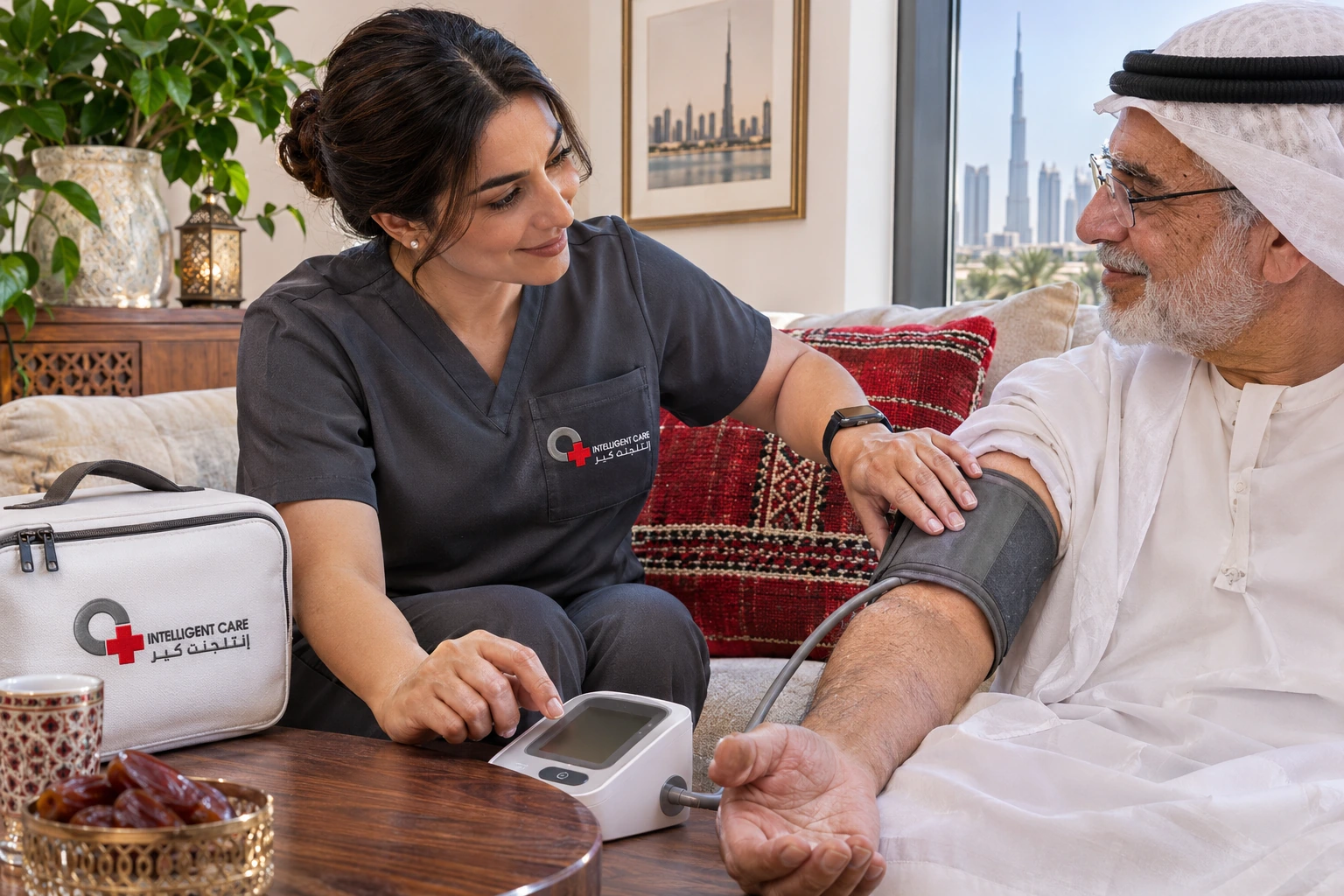
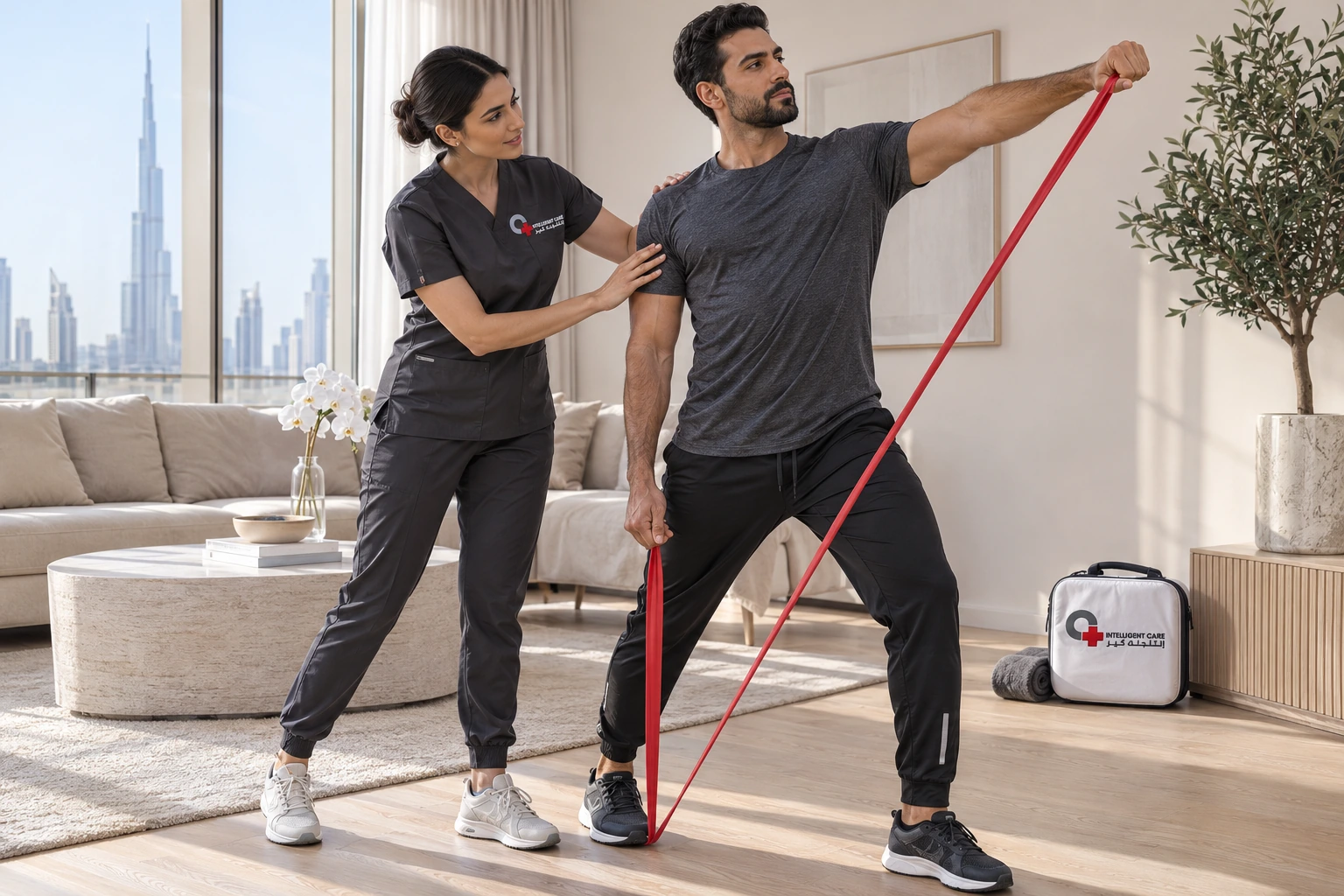
Ask what helps the person
Let the person describe priorities in their own words. Avoid judging the severity only by appearance or comparing it with someone else’s experience.

Pain-management support · Dubai
Pain can interrupt sleep, movement and the ordinary parts of a day. Intelligent Care provides nursing support at home in Dubai for an established pain-management plan: carrying out agreed care, noticing changes and helping the responsible clinician understand how the plan is working for you.

 Clinical author assignmentDr Toqa IbrahimTwo clinical perspectivesProfiles & DHA directory links Guidance with sourcesExplore the references
Support for prescribed pain care
Tell us about the pain, the clinician responsible, current prescriptions and the nursing tasks being requested. A standard duty can support agreed care; a new diagnosis, specialist procedure or uncontrolled symptom needs the appropriate clinical assessment first.
Understand the care

Pain may follow an operation or injury, accompany an illness or persist over a longer period. The cause and treatment plan should be assessed by the appropriate clinician. Nursing support works within that plan; it does not replace the assessment that explains why pain is occurring.
A useful pain discussion includes location, timing, what worsens or eases it and its effect on movement, rest and everyday tasks. A number can help describe intensity, but the person’s experience and a change from their usual pattern are also important. People who find communication difficult may need an adapted assessment approach.
Longer-term pain care can involve several approaches rather than one medicine alone. A clinician may coordinate movement, rehabilitation, psychological support or other treatment according to the situation. The nurse helps follow the agreed components and raises concerns about effectiveness or unwanted effects for review.
Read the clinical sourcesCare around the person
Relatives can help make the plan easier to follow without taking over prescribing decisions.

Let the person describe priorities in their own words. Avoid judging the severity only by appearance or comparing it with someone else’s experience.
If a relative helps with medicines or observations, agree how this is recorded so doses and symptoms are not reconstructed from memory.
Discuss practical help with rest, meals, clothing and movement within the clinical advice. The aim is a manageable day, not pressure to meet a fixed recovery target.
Your discussion priorities
Select the details you want to bring into the conversation. This is not a tool for identifying the cause or choosing a medicine.
Describe where it is, when it started and whether the pattern has changed. New pain should not automatically be attributed to a familiar long-term condition.
Share the current medicines, timing and any written as-needed instructions. Include other products used for pain so the clinician sees the complete picture.
Explain what happens at night, whether positions are comfortable and which ordinary activities are disrupted. These details can help the clinical review.
Tell us about walking, transfers or activities avoided because of pain. Nursing support and physiotherapy may have different contributions.
Report unwanted effects, problems taking medicines or concern that the plan is no longer helping. Do not change the regimen without appropriate advice.
Mention hearing, language, cognitive or other needs that affect how the person describes pain. A relative’s observations can help, while the person remains central.
Your discussion list
Choose the points you would like to discuss.
The first assessment
The nursing discussion should distinguish a stable support need from a new problem needing medical review.

THE CLINICAL CONVERSATION01—04
Identify the diagnosis or procedure, current clinician and any new symptom that changes the urgency.
Review the prescribed tasks, medicine instructions, relevant precautions and what has already been tried.
Decide what to record about symptoms, function and response so the information answers a clinical question.
Confirm who should be contacted for poor control, unwanted effects or a new pain pattern, and when an urgent assessment is needed.
What the care involves
The appropriate pain plan is individualized. Nursing helps deliver and communicate the parts specifically agreed.
| Part of support | Purpose | Keep clear |
|---|---|---|
| 01Pain observations | Record the person’s description and relevant changes in function or comfort. | A score does not diagnose the cause. |
| 02Prescribed medicine support | Follow the active regimen within professional scope and document what is given. | Dose changes and new prescriptions require the appropriate prescriber. |
| 03Comfort measures | Support positioning and other agreed measures suited to the person. | Do not apply an unfamiliar treatment over an injury or surgical area without advice. |
| 04Rehabilitation coordination | Share movement-related concerns with the clinician or physiotherapist. | Exercise or manual treatment requires appropriate assessment. |
| 05Treatment review | Communicate inadequate benefit or unwanted effects to the responsible team. | Persistent pain is not a reason to escalate medication independently. |
The care pathway
A pain plan should be reviewed for the individual, not continued automatically because it was once prescribed.
Explain the symptoms and their effect on daily life.
Carry out the agreed nursing tasks and prescribed care.
Record benefit, new symptoms or unwanted effects.
Bring the findings to the responsible clinician.
Explore a stage to bring it into focus. Every stage stays visible.
Before care arrives
A few relevant details are more useful than a long list of guesses about the cause.
A personal reminder list.
Nothing is sent or saved.
People and responsibilities
The team is matched to the assessed need rather than a single universal pain package.
Assesses the cause, chooses treatment and reviews medicine effectiveness or adverse effects.
Supports agreed care, documents observations and communicates changes requiring clinical review.
Provides a separate assessed contribution where movement, function or another specialty is relevant.
Agree practical duties and contact routes while keeping the person’s priorities visible.
Read the real team profiles and their professional-directory references. Your assigned professional and the scope of care are confirmed through the care arrangement.
Meet our clinical teamContinuity of care
The next review should connect symptom relief with everyday life and tolerability.
Is the person able to rest or manage important tasks more comfortably, or is the burden unchanged?
Are there symptoms or medicine difficulties that should be reviewed by the prescriber or pharmacist?
Has the pain changed in location, severity or character, suggesting a need for reassessment?
Who reviews the record, what is the planned follow-up and what change should prompt earlier contact?
When to seek medical help
Follow the individual clinical advice and seek help for serious or rapidly changing symptoms.
Immediate medical attention
Prompt clinical assessment
Practical arrangements
Choose the nursing period around the work that has been agreed.
Compare available nursing plans by duration and starting price. The team confirms which clinical duties are appropriate for your needs.
Injections, infusions, pumps or other procedures require specific confirmation of prescription, competence, supplies and follow-up.
A doctor review, physiotherapy or another specialty may be a separate part of the plan. No automatic bundle or guaranteed outcome is implied.
Your questions
The cause requires appropriate clinical assessment. Nursing can assess and record the care need, support an established plan and identify concerns for medical review.
Discuss inadequate control with the prescriber. The nurse can communicate observations, but a care booking does not authorize a new medicine or dose.
Not necessarily. Depending on the cause, the clinical plan may include movement, rehabilitation, psychological or other support. The appropriate combination is individualized.
Follow the current prescription and ask the prescriber or pharmacist if instructions are unclear. Do not give an extra dose based on a website or an assumed nursing plan.
Yes, nursing support can follow the discharge pain plan and report changes. Keep surgical follow-up in place and use the hospital’s advice for new or concerning symptoms.
Tell the team about communication or cognitive needs. Assessment may need an adapted approach and observations from people who know the person, rather than relying only on a verbal number.
Not automatically. Any injection or specialist procedure needs the appropriate prescription, supplies, professional scope and service confirmation.
No. The aim is appropriate support and useful clinical review. Outcomes depend on the cause, treatment and individual circumstances; the plan should be discussed with the treating team.
Expertise with a name
Explore the named clinical profiles, their professional roles and their Dubai Health Authority directory records.
Author assignment
General Practitioner
Dr Toqa Ibrahim is a DHA-licensed General Practitioner with Alpha Intelligent Care Home Healthcare Center. Her clinical profile brings the general-practice perspective into our approach to care at home.

Review assignment
Specialist Clinical Pathology
Dr Nirupama Sabhapathy is a DHA-licensed Specialist in Clinical Pathology at Intel Lab. Her published Intel Lab profile describes more than 25 years in medicine and her role as Laboratory Director.
Professional registration describes each clinician’s role. The clinical assessment and the person responsible for your care are confirmed separately.
More care guides


The wider picture
Explore related support, or speak to us about combining services into one plan.
About this guide
General information supports the care conversation; your own assessment determines the plan. Company service information and independent clinical guidance are listed separately below.
Care that comes to you
Across Dubai.
Abu Dhabi — coming soon.