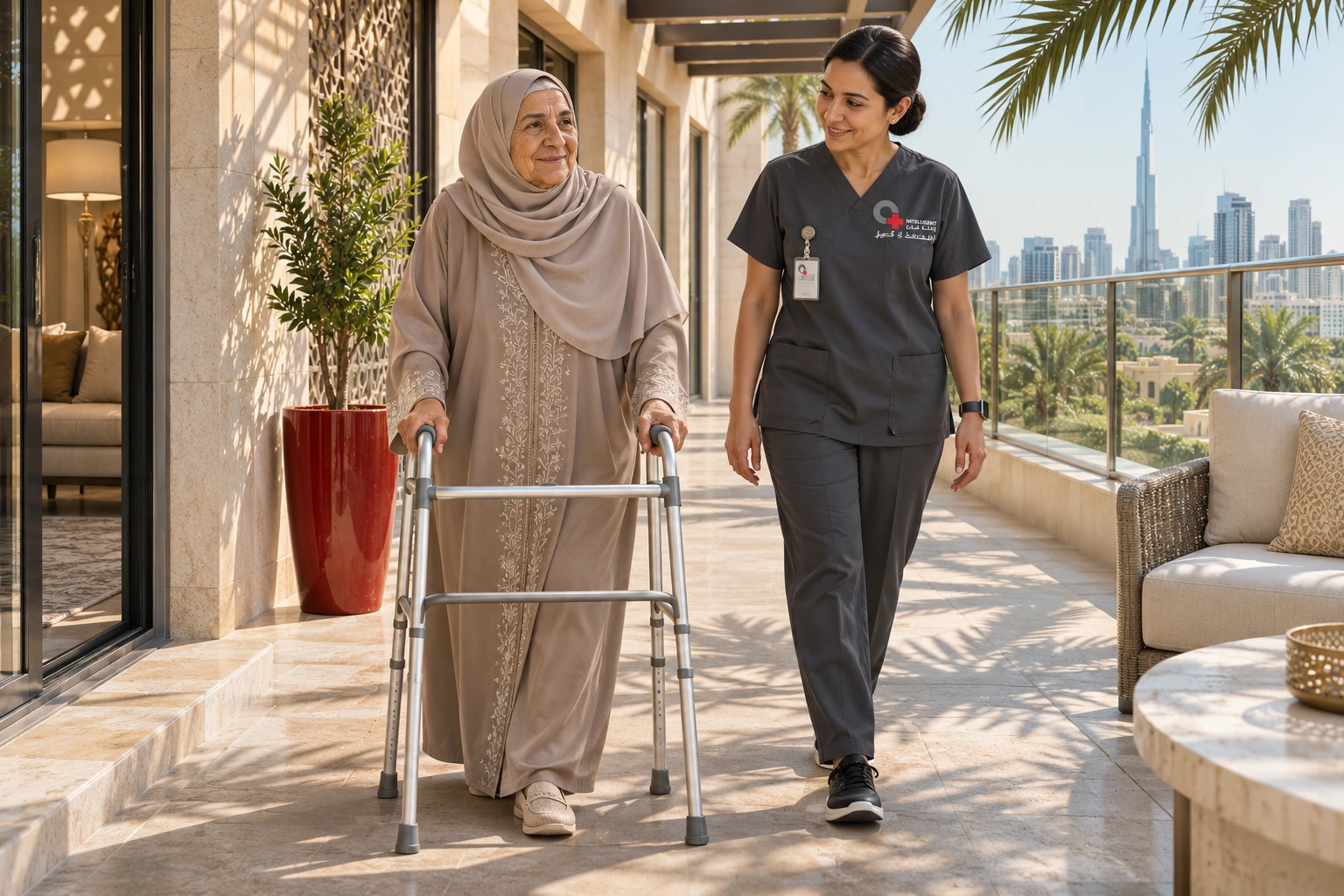
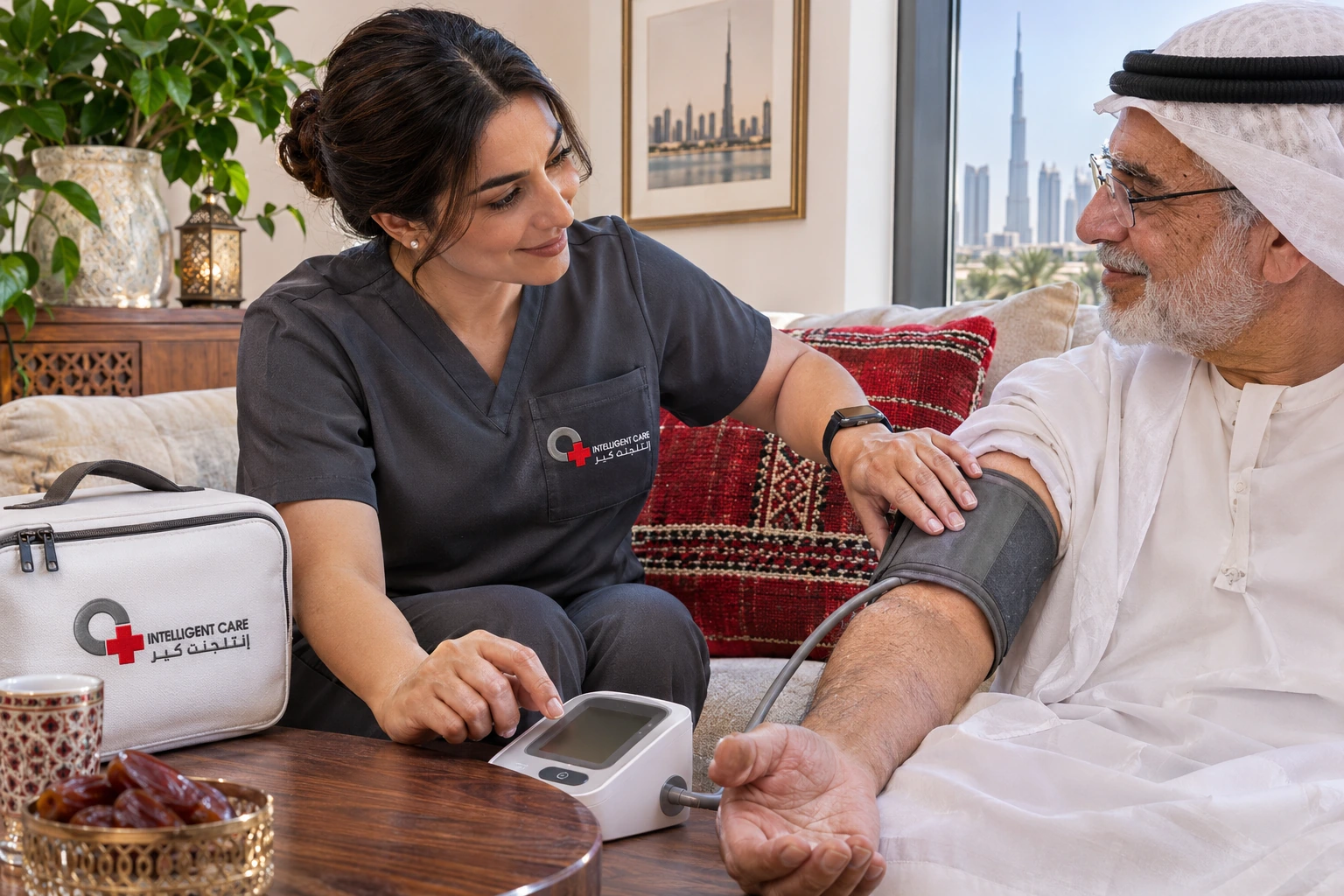
Explain preferences respectfully
Share useful information about routines, products and communication without speaking over the person. Ask whether they want a family member present during the discussion.

Personal care & dignity · Dubai
Help with washing, dressing or everyday personal routines should preserve the older person’s privacy, choices and sense of self. We begin with how they prefer to be supported, what they can manage and which tasks need practical or clinical help.

 Clinical author assignmentDr Toqa IbrahimTwo clinical perspectivesProfiles & DHA directory links Guidance with sourcesExplore the references
Personal care and daily-living support
Tell us which personal-care tasks need support and how the person wants help offered. Discuss privacy, communication, mobility and any skin or clinical concerns. A caregiver can assist with agreed daily activities; wounds, devices or other nursing requirements need the appropriate professional role.
Understand the care

Personal care involves intimate routines that people may have managed independently for decades. Needing help does not remove the right to choose how, when and by whom support is offered. Begin with the person’s preferences and abilities, rather than treating the task as something to complete as quickly as possible.
Practical support may involve preparing supplies, helping with clothing, assisting with washing or supporting an agreed toileting routine. The details depend on mobility, communication, comfort and the home environment. A clear plan should state what the caregiver does and when a nurse or another clinician is needed.
Changes during personal care can be clinically relevant, but observation is not diagnosis. Pain, damaged skin, a new difficulty moving or an unusual change in behaviour should be reported appropriately. The caregiver should not turn an intimate task into an unqualified medical examination or ignore a concern because the visit is described as practical care.
Read the clinical sourcesSupport for the caregiver
Families can help the arrangement work while respecting that personal care belongs to the person receiving it.

Share useful information about routines, products and communication without speaking over the person. Ask whether they want a family member present during the discussion.
Allow time for explanation and participation. Rushing can make an already intimate task feel unsettling, particularly when mobility or communication is difficult.
A practical handover should include relevant concerns and responsibilities, not unnecessary intimate detail. Agree the main contact and how clinical concerns are escalated.
The rhythm of a day
Choose priorities for the practical care discussion. The older person’s own preferences remain central.
Explain the preferred routine, what the person can do themselves and any difficulty with access or movement. The setup and assistance should be agreed, not improvised during an intimate task.
Share clothing preferences and the level of help needed. Small choices can preserve identity and control even when a person needs substantial assistance with other parts of the day.
Discuss privacy, timing, mobility and supplies sensitively. A new bladder or bowel concern may need clinical review rather than being treated only as a practical inconvenience.
Report soreness, broken skin or a new concern to the appropriate professional. A caregiver’s observation is not a wound diagnosis or permission to start a treatment.
Explain how the person prefers information, including hearing, vision, language or cognitive needs. Give time to understand and respond before beginning a task.
Agree who is involved, what information is shared and how support is handed over. Intimate care details should not be circulated more widely than necessary.
Your discussion list
Choose the points you would like to discuss.
The first assessment
The first discussion should connect practical needs with privacy, preferences and clinical requirements.

THE CARE CONVERSATION01—04
Involve the older person directly and identify the tasks they want assistance with. Explain choices and communication preferences rather than relying only on a relative’s description.
Discuss mobility, the bathroom or care space, supplies and the assistance currently needed. Any unsafe transfer or setup requires appropriate assessment.
Identify wounds, devices, skin problems or other nursing needs. The professional role and instructions must be confirmed instead of adding them informally to caregiving.
Ask whether the arrangement feels respectful and useful. Changes in ability, pain or preference should trigger a review rather than the same routine being repeated automatically.
Before care arrives
A few clear preferences can make the first visit more comfortable.
A personal reminder list.
Nothing is sent or saved.
What the care involves
The care plan should describe the assistance clearly enough to preserve both consistency and choice.
| Daily activity | Practical support | When to seek another role |
|---|---|---|
| 01Washing and grooming | Prepare the agreed supplies and assist at the level the person needs. | Clinical skin concerns or complex mobility requirements need appropriate assessment. |
| 02Dressing | Support preferred clothing and the parts of the task the person can do. | New pain or a sudden loss of function should not be treated as ordinary ageing. |
| 03Toileting | Follow the agreed routine with privacy and appropriate assistance. | New urinary, bowel or continence concerns may need clinical review. |
| 04Skin observations | Report relevant changes noticed during ordinary care. | Wound assessment, dressings and clinical treatment require the appropriate professional. |
The care pathway
The sequence is practical and person-centred, not a checklist that overrides preference.
Understand the person’s choices and level of help.
Make the agreed space, supplies and assistance ready.
Support the task at the appropriate pace and scope.
Respond to changes in comfort, ability or preference.
Explore a stage to bring it into focus. Every stage stays visible.
People and responsibilities
Age alone does not determine the professional you need. Start with the person’s priorities, the practical help required and any clinical task in the existing plan.
Supports agreed everyday activities and reports relevant changes. A caregiver does not diagnose illness, independently alter medicines or replace a nurse for clinical procedures.
Assesses and delivers nursing care within the agreed clinical scope, instructions and professional responsibilities. Explain specialist procedures or equipment before booking so competence and supplies can be confirmed.
Make the relevant clinical decisions and guide specialist treatment, rehabilitation or nutrition where needed. Home support should connect with that advice rather than replace it by default.
Coordinate practical arrangements and agreed communication. Involve the older person directly, respect their choices and identify who may receive information, rather than assuming every relative has the same authority.
Read the real team profiles and their professional-directory references. Your assigned professional and the scope of care are confirmed through the care arrangement.
Meet our clinical teamContinuity of care
Personal care should remain comfortable, appropriate and responsive to change.
Ask whether help is being offered in the way the person prefers and whether boundaries are being respected.
Notice when a task becomes more painful or difficult and seek appropriate review rather than simply increasing assistance.
Ensure relevant skin, continence or other changes reach the right professional and that instructions are updated.
Review duties, supplies and support periods as needs change, keeping the person involved in decisions.
When to seek medical help
Do not dismiss a new problem as an unavoidable part of ageing or hide it inside an ordinary personal-care routine.
Immediate medical attention
Prompt clinical assessment
Practical arrangements
Choose nursing or caregiving for the agreed duties, then the short- or long-term period that fits. You can compare the published prices for standard plans and add your chosen period to the care bag. Custom and annual arrangements begin with a care enquiry so the team can clarify the duties, schedule and price.
Most families begin by arranging the support they need directly. The plan should make the professional role, coverage period, duties and additional services clear. A monthly 24-hour arrangement is coordinated coverage, not one person working continuously without rest.
Intelligent Care accepts CDA payment for approved arrangements. Share the approval so the team can confirm its scope before care begins; agreed care normally proceeds on credit and CDA settles later. Approval is not automatic, and CDA is the payer in this pathway, not the clinical regulator.
An earliest-available request remains pending agreement and does not collect payment. Use the custom route for a complex schedule or uncertain clinical scope. Insurance, where relevant, is checked separately against the policy and any authorization requirements.
Your questions
Their preferences should be central wherever possible. Discuss timing, privacy, communication and the tasks they want to manage themselves. Practical support should preserve choice rather than treat the booking relative as the only decision-maker.
No. A caregiver can assist with agreed everyday activities. Wound treatment, devices and other clinical tasks may require a nurse or another qualified professional. Describe those requirements before booking so the role is appropriate.
Discuss the specific tasks, level of help and home setup with the team. Duties should be clearly agreed, including mobility or equipment needs. Do not assume every personal-care task is suitable for one person without assessment.
Allow time, explain what is proposed and ask how help could feel more comfortable. Respect preferences and communication needs. A new or marked change in behaviour or distress may also need appropriate clinical consideration rather than being forced through a routine.
A caregiver can report a concern noticed during ordinary care. Assessment, dressing and treatment belong with the appropriate clinical professional and instructions. Do not add a wound procedure to practical caregiving without confirming the role.
Discuss what the person receiving care wants and what is appropriate for the task. Some prefer a familiar person nearby; others want privacy. The arrangement should respect that preference rather than assume one approach suits everyone.
Intelligent Care accepts CDA payment for approved care arrangements. Share the authorization so scope can be checked; agreed care normally proceeds on credit with later settlement. Approval is not automatic and does not replace clinical assessment where needed.
Start with the duties and professional level, then choose a suitable standard period through your care bag. Use a custom enquiry for complex scope or schedules. The duration of a booking does not change the professional boundaries of the work.
Expertise with a name
Explore the named clinical profiles, their professional roles and their Dubai Health Authority directory records.
Author assignment
General Practitioner
Dr Toqa Ibrahim is a DHA-licensed General Practitioner with Alpha Intelligent Care Home Healthcare Center. Her clinical profile brings the general-practice perspective into our approach to care at home.

Review assignment
Specialist Clinical Pathology
Dr Nirupama Sabhapathy is a DHA-licensed Specialist in Clinical Pathology at Intel Lab. Her published Intel Lab profile describes more than 25 years in medicine and her role as Laboratory Director.
Professional registration describes each clinician’s role. The clinical assessment and the person responsible for your care are confirmed separately.
More care guides



The wider picture
Explore related support, or speak to us about combining services into one plan.
About this guide
General information supports the care conversation; your own assessment determines the plan. Company service information and independent clinical guidance are listed separately below.
Care that comes to you
Across Dubai.
Abu Dhabi — coming soon.