01Timeline
When it began
Was the change sudden or gradual? Mention the day symptoms started and whether there was a period of improvement before you felt worse.

Fever & flu assessment · Dubai
When you feel too unwell to travel, a home consultation can bring an assessment into familiar surroundings. Tell us what has changed, how long it has been happening and any existing health concerns. The doctor considers the whole picture before recommending care.

Adult doctor assessment
Fever, cough, aches and tiredness can overlap across several illnesses. A doctor visit helps assess the symptoms, examine you where appropriate and explain the next step. Tests, medicines and additional services are considered separately according to the findings.
Understand the care
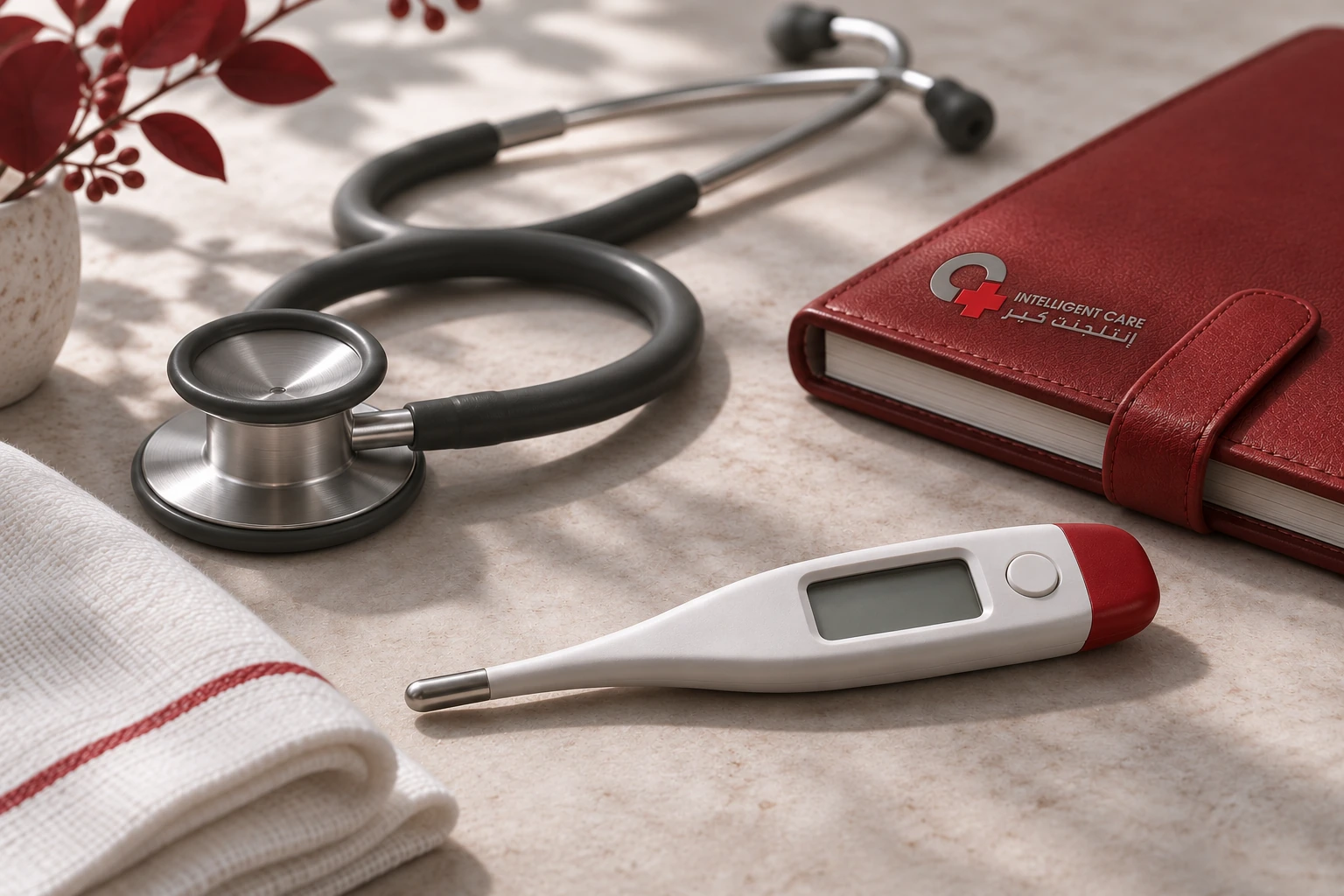
Flu often starts suddenly, with fever, aching muscles, exhaustion, a dry cough or a sore throat. A cold may develop more gradually and affect the nose and throat more prominently. Those patterns can help a conversation, but they do not establish the diagnosis for an individual person.
Fever is one part of the history. The doctor also considers breathing, comfort, fluid intake, alertness, the course of the illness and relevant medical conditions. Not everyone with flu has every symptom, and a person can need medical care even without a high temperature.
This page focuses on arranging an adult assessment at home. Infants, children, people who are pregnant, older adults and people with certain chronic conditions may need a different level or setting of care. Explain that context at the first contact.
Read the clinical sourcesYour discussion priorities
Select the points you want to discuss. These are conversation prompts, not a symptom checker or a diagnosis.
Was the change sudden or gradual? Mention the day symptoms started and whether there was a period of improvement before you felt worse.
Describe aches, cough, throat discomfort, headaches or fatigue in your own words. Explain which symptom is most disruptive rather than trying to name the infection.
Say if ordinary activities have become harder or you feel short of breath. New or worsening breathing difficulty requires prompt assessment, and severe difficulty is an emergency.
Tell the doctor if you cannot manage your usual drinks or meals, have vomiting or diarrhoea, or have noticed a change in passing urine. Do not rely on a temperature alone.
Share pregnancy, recent birth, asthma, diabetes, heart or lung disease, immune suppression and other relevant conditions. These can change how urgently a clinician needs to review you.
Have medicine names, doses already taken and allergy information available for the clinician. Include over-the-counter products so the doctor can check the complete picture.
Your discussion list
Choose the points you would like to discuss.
The first assessment
A useful visit has room for your experience, a focused examination and an explanation of the decisions. The exact examination depends on the symptoms and the clinician’s judgment.

THE CLINICAL CONVERSATION01—04
The doctor asks about onset, progression, contacts, travel where relevant, medicines and existing conditions. Share any prior assessment or test result for this illness.
Temperature and other observations may be taken when appropriate. The clinician assesses the relevant body systems; equipment does not replace the clinical conversation.
Ask what the findings suggest, what remains uncertain and which possibilities need further assessment. Some symptoms cannot be fully evaluated in a home setting.
Discuss whether the next step is a care plan, a test, a review, specialist assessment or urgent transfer. Leave with a clear understanding of what changes should prompt help.
What the care involves
A fever page does not select a standard medicine or a test bundle. Each decision should answer a clinical question.
| Part of care | What it may involve | What to clarify |
|---|---|---|
| 01Clinical examination | Assessment of the symptoms and relevant physical findings at the visit. | What can be assessed at home, and what needs another setting? |
| 02Diagnostic testing | A test may be recommended when its result would help guide care. The exact test and collection arrangements are confirmed separately. | Why is this test useful for me, and who will explain the result? |
| 03Medicines | Any prescription follows the doctor’s assessment. Antibiotics do not treat viral flu; a doctor decides whether there is another reason for them. | How should I follow my own prescription, and what should I report? |
| 04Referral or review | A changing illness, risk factors or an uncertain diagnosis may require another review or a higher level of care. | Who should I contact, and what would make the plan change? |
Care around the person
A home visit takes place in a shared environment. A little preparation helps the consultation and makes the household’s needs visible.

Mention anyone who is particularly vulnerable and any practical difficulty keeping the visit area calm. The clinician can advise on appropriate precautions for the situation.
A family member can help gather medicines, observations and previous advice, with the patient’s agreement. Record facts without repeatedly checking or trying to diagnose.
If someone else will help after the visit, clarify what they need to know and what the patient agrees to share. Keep urgent instructions separate from routine appointment details.
The care pathway
The sequence follows the clinical need. It is not a promised recovery timetable.
Explain the current symptoms and important health history before the visit.
The doctor reviews the history and examines what is appropriate at home.
Follow the individualized advice and arrange any agreed tests or referral.
Seek help for deterioration and follow the review advice you were given.
Explore a stage to bring it into focus. Every stage stays visible.
Before care arrives
Keep these details ready if they are available. Do not delay urgent medical care to complete a checklist.

A personal reminder list.
Nothing is sent or saved.
People and responsibilities
The clinician responsible for a visit and any further services should be clear. The people helping arrange care have different roles from the people making clinical decisions.
Assesses the illness, explains clinical decisions and identifies any need for another setting or specialty.
Helps with the service request, location and appointment arrangements. Share clinical concerns so the request can be appropriately directed.
Coordinates an agreed test or collection when required. The test remains a separate service with its own preparation and result pathway.
Previous advice, records and follow-up remain relevant. Share them so new care is informed by the history.
Read the real team profiles and their professional-directory references. Your assigned professional and the scope of care are confirmed through the care arrangement.
 Explore a clinical profileDr Toqa IbrahimGeneral Practitioner
Continuity of care
A consultation is easier to act on when the next decision is clear. Ask the doctor to explain the plan in language you can use at home.
Ask about the likely course in your situation and which changes would be outside that expectation.
Clarify the warning signs for you and the appropriate place to seek help. Do not wait for a routine review if you deteriorate.
If a test is arranged, establish how the result will be discussed and what to do if your symptoms change before then.
Confirm any recommended review and who to contact if you are not improving. No single follow-up schedule suits every illness.
When to seek medical help
These examples are not an exhaustive triage list. If you are seriously concerned or symptoms are deteriorating, seek medical assessment.
Immediate medical attention
Prompt clinical assessment
Practical arrangements
Book a home visit or request the earliest available appointment. For an earliest-available request, the time remains to be agreed with the team; do not use it for an emergency.
The price shown is for the doctor consultation. Ask about any separately recommended test, medicine, additional visit or service before it is arranged.
Coverage depends on your policy, benefit and authorization requirements. Visit insurance support or ask the care team which documents are needed; coverage is not guaranteed by booking a visit.
Your questions
No. Fever and flu-like symptoms have several possible causes. The history, examination and sometimes tests help a clinician decide the next step. The page name describes a reason to seek assessment, not a confirmed diagnosis.
Share the hotel name, room, contact and access instructions when requesting a Dubai home visit. The team confirms practical arrangements and suitability for the service. Serious symptoms still require urgent care.
No. Antibiotics do not treat viral flu. A doctor considers whether a prescription is appropriate after assessment; do not start, share or change medicines because of this page.
Usually the starting point is the clinical conversation. Share existing results if you have them. Ask the doctor whether a test would help and which exact test is being recommended rather than choosing a broad bundle yourself.
Tell the team the child’s age and symptoms before arranging care. This example is written around adult assessment. Young infants with fever and children with serious warning signs need prompt medical assessment in an appropriate setting.
Mention it at the first contact. Pregnancy, recent birth, older age, immune suppression and some chronic illnesses can change the urgency and clinical approach. Do not wait for a routine slot if you feel very unwell.
The clinician may recommend another setting when a home assessment is insufficient or symptoms require urgent treatment. For a medical emergency in the UAE call 998; a routine home-visit request is not an ambulance service.
If tests are recommended, ask who will review the results with you, how you will receive them and what follow-up is needed. A result should be interpreted alongside your symptoms and assessment; seek urgent help for worsening symptoms rather than waiting for a report.
The wider picture
Explore related support, or speak to us about combining services into one plan.
About this guide
General information supports the care conversation; your own assessment determines the plan. Company service information and independent clinical guidance are listed separately below.
Care that comes to you
Across Dubai.
Abu Dhabi — coming soon.