
Arrange your collection
Choose your location, add the test to your care bag and select a time. If you are booking for someone else, assign the test to them in checkout.
Choose collection location
Biochemistry · Individual laboratory test
This panel measures sodium, potassium and chloride together. Their pattern can help evaluate fluid changes, kidney problems or the effects of medicines.
 Clinical authorDr Nirupama SabhapathySpecialist Clinical Pathology

Understanding the test
Also called Sodium, Potassium & Chloride
A clinician may request the panel after fluid loss or to follow a medicine that affects salt and water balance. The three results are measured on the same sample.
The clinician can assess several salts together following fluid loss.
Some water tablets can alter sodium and potassium in different ways.
Inside this test
Before your sample
No fast is required for this panel alone. Tell the team about diuretics, blood pressure medicines, potassium supplements and any recent change in fluid intake.
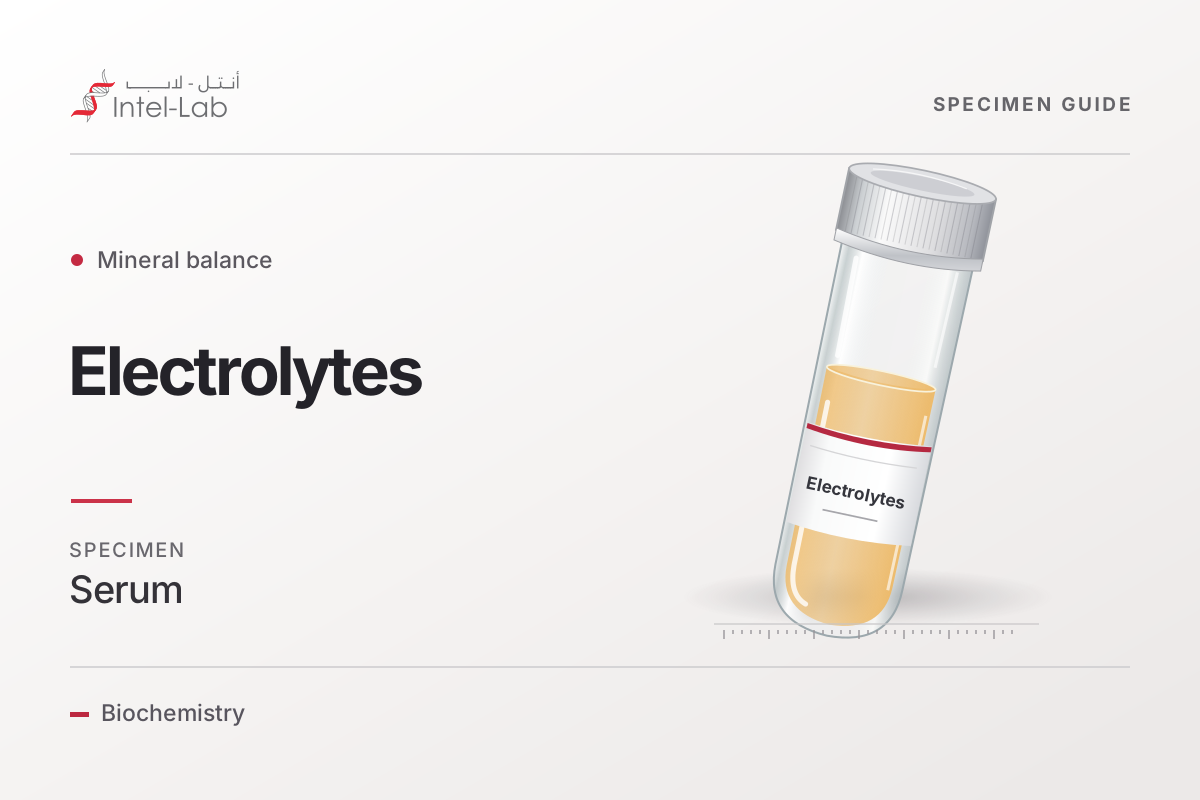
A clinician takes a small sample of blood from a vein. The laboratory uses serum, the liquid separated from the blood after it clots.
Smart Report
24 hoursLaboratory turnaround
 Result guide
Sodium, potassium and chloride have different roles and can change in different directions. A result that needs urgent follow-up should be handled on the clinician's instructions.
From sample to follow-up
Choose your location, add the test to your care bag and select a time. If you are booking for someone else, assign the test to them in checkout.
Choose collection locationLook for Electrolytes in your report. Use the sample type and collection time when comparing it with an earlier report.
Explore Smart Report
Bring your medication list, especially diuretics. Ask whether one electrolyte needs checking again or whether the whole pattern should be followed.
Clinical expertise

Patient questions
Intel Lab lists sodium, potassium and chloride. Magnesium and ionized calcium have separate test entries when those are the measurements your clinician requests.
Both high and low potassium can affect your heart’s rhythm. A high potassium can follow reduced kidney clearance, potassium-sparing diuretics, ACE inhibitors, potassium supplements or adrenal insufficiency, or can be falsely raised by a difficult draw. A low potassium often follows vomiting, diarrhoea, thiazide or loop diuretics, or excess aldosterone or cortisol.
Potassium is packed inside red blood cells, so if some cells break during a difficult draw or the sample sits too long before processing, the reported value rises without your body having changed. A fresh sample can check whether this happened. Follow the timing your clinician gives you. If you have been told to seek urgent care for a high result, go as directed even if you feel well.
KEEP EXPLORING
Open a package to see exactly which tests it includes.

Measures sodium, potassium and chloride: the electrolytes that regulate hydration, nerve signalling and acid-base balance. No fasting required.

Creatinine, eGFR, urea nitrogen, uric acid and calcium from one blood sample, to check how well your kidneys are functioning.

Blood count, liver, kidney, cholesterol, blood sugar and urine tests: the essentials in one visit.

A complete blood count with liver enzymes, cholesterol, kidney markers and fasting blood sugar from one blood sample.
Choosing for a particular need?
We can help you read the options.
Your next step
Written by Dr Nirupama Sabhapathy, Specialist Clinical Pathology. Medically reviewed by Dr Joyce Jose, Specialist Clinical Pathology, on .
Catalogue information and AED price checked on 2 November 2026. Clinical suitability, preparation, collection arrangements and turnaround are confirmed for your selected test.