Arrange your collection
Choose your location, add the test to your care bag and select a time. If you are booking for someone else, assign the test to them in checkout.
Choose collection location
Vitamins & Minerals · Individual laboratory test
Zinc is involved in growth, wound healing and taste. Serum zinc may help assess suspected deficiency when considered alongside diet and health history.
 Clinical authorDr Nirupama SabhapathySpecialist Clinical Pathology
Understanding the test
Also called Serum Zinc
A clinician may consider zinc measurement when symptoms occur in the context of low intake, poor absorption or prolonged supplementation. The full dietary history matters.
Serum zinc may be useful when dietary, absorption or clinical concerns suggest low zinc status.
Timing, recent intake and inflammatory illness can influence the measured level.
Before your sample
Arrange the fasting morning sample requested by the laboratory. Record recent zinc supplements and illness. Ask the clinician about prescribed products before making any change.
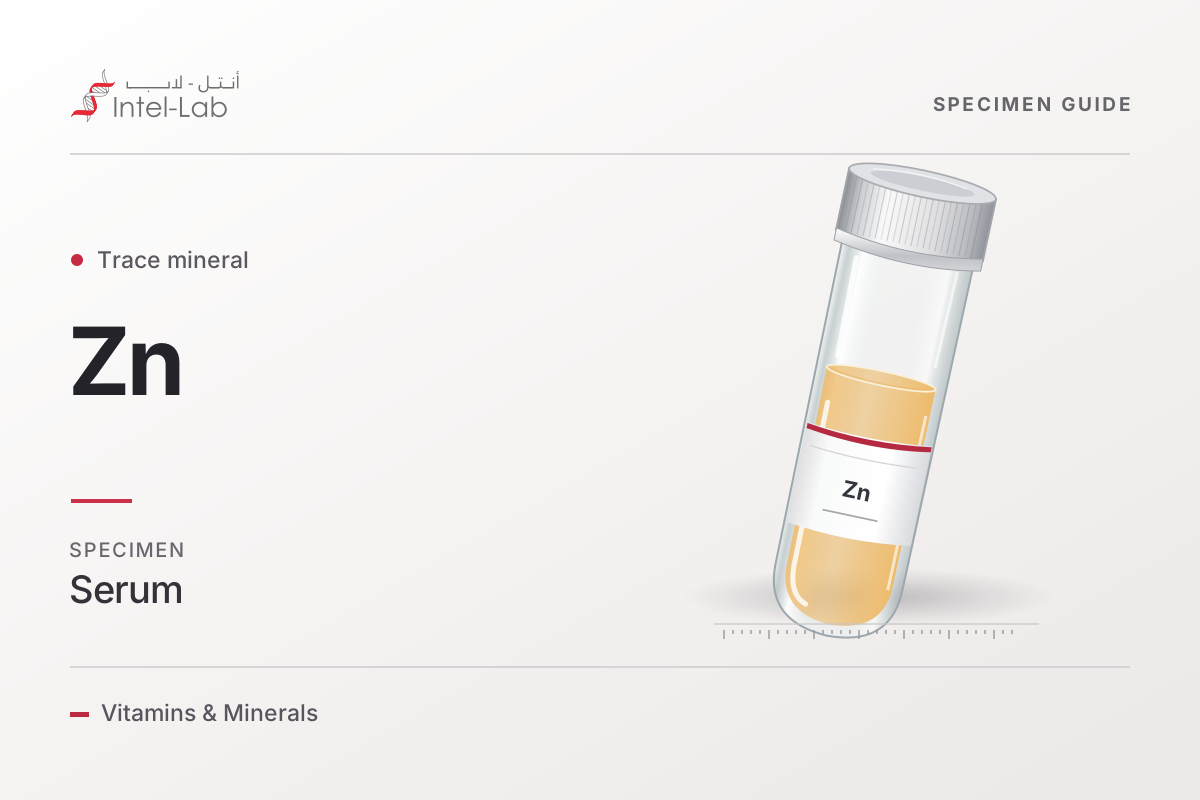
A clinician takes a small sample of blood from a vein. The laboratory uses serum, the liquid separated from the blood after it clots.
Smart Report
24 hoursLaboratory turnaround
 Result guide
A low serum concentration is a clue rather than a direct measure of every tissue store. Timing, inflammation and recent illness can influence it.
From sample to follow-up
Choose your location, add the test to your care bag and select a time. If you are booking for someone else, assign the test to them in checkout.
Choose collection locationLook for Zinc in your report. Use the sample type and collection time when comparing it with an earlier report.
Explore Smart Report
Share the collection time, any recent infection and zinc-containing products before interpreting the serum concentration as a dietary deficiency.
Health packages
Compare the other tests in each package before choosing.
Clinical expertise

Patient questions
Yes. Circulating zinc changes during illness and with the timing of collection. A clinician should interpret it with symptoms and recent supplement use.
Serum zinc has a daily rhythm and drops for a period after a meal, so an afternoon or post-meal sample can read lower than a morning one for reasons that have nothing to do with your nutrition. Standardising the timing makes repeat results comparable.
A high result usually comes from a zinc supplement, lozenge or multivitamin taken shortly before the draw. It can also be caused by contamination from a zinc-containing skin product such as sunscreen or calamine, or by red cells breaking during collection. Occupational exposure, such as welding fumes, is a less common cause. An unexpectedly high value is often repeated.
A low serum result after an illness may not mean your usual intake is low. Review the dose in all your supplements with your clinician first. Taking high doses of zinc for weeks can reduce copper absorption and create a second deficiency.
KEEP EXPLORING
Open a package to see exactly which tests it includes.

A focused panel of essential vitamins and minerals to uncover hidden nutritional deficiencies.

An extensive panel for active individuals, covering inflammation, iron, metabolic, hormonal, thyroid and nutritional status.

A focused panel checking the iron, thyroid, hormonal and vitamin markers most commonly linked to hair loss.

Vitamin D, vitamin B12 and folate measured from one blood sample, no fasting needed.
Choosing for a particular need?
We can help you read the options.
Your next step
Written by Dr Nirupama Sabhapathy, Specialist Clinical Pathology. Medically reviewed by Dr Joyce Jose, Specialist Clinical Pathology, on .
Catalogue information and AED price checked on 2 November 2026. Clinical suitability, preparation, collection arrangements and turnaround are confirmed for your selected test.