Arrange your collection
Choose your location, add the test to your care bag and select a time. If you are booking for someone else, assign the test to them in checkout.
Choose collection location
Haematology · Individual laboratory test
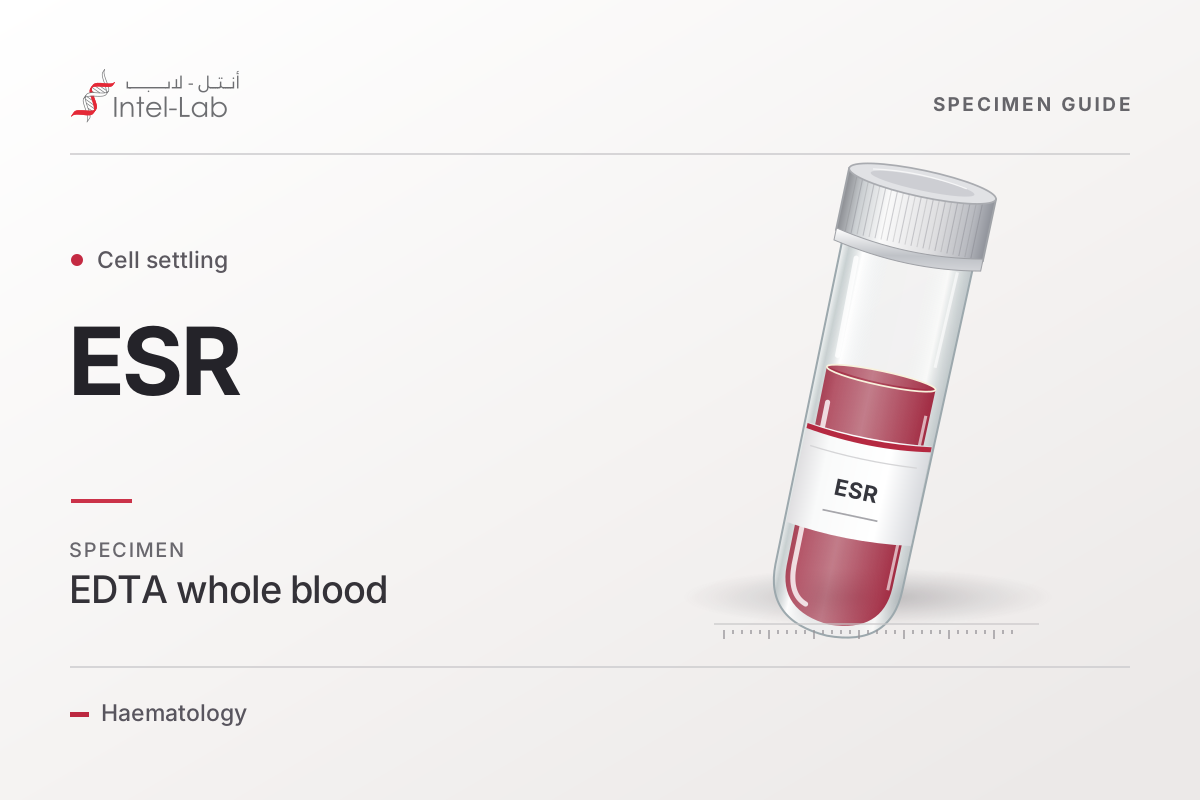
ESR measures how quickly red cells settle under defined laboratory conditions. It is an indirect indicator of inflammation.
 Clinical authorDr Nirupama SabhapathySpecialist Clinical Pathology
Understanding the test
Also called Inflammation Marker (ESR)
ESR may support investigation or monitoring of certain inflammatory conditions. A previous result and a record of symptoms can be particularly helpful in follow-up.
ESR reflects how quickly red cells settle under standardised conditions.
The trend may help a clinician assess change alongside symptoms and other tests.
Before your sample
ESR alone requires no fast. Mention recent infection, pregnancy or anaemia and provide previous ESR or CRP results if this is a follow-up.
The clinician takes blood from a vein into a tube that keeps it from clotting. The collection team sends the labelled specimen to the laboratory.
Smart Report
24 hoursLaboratory turnaround
 Result guide
A raised ESR has many possible explanations. Age, anaemia and factors other than active inflammation can change it.
From sample to follow-up
Choose your location, add the test to your care bag and select a time. If you are booking for someone else, assign the test to them in checkout.
Choose collection locationLook for Erythrocyte Sedimentation Rate (ESR) in your report. Use the sample type and collection time when comparing it with an earlier report.
Explore Smart Report
Describe how symptoms changed over the same period as the ESR rather than comparing isolated results without dates.
Clinical expertise

Patient questions
Both can reflect inflammation, but their timings and the factors influencing them differ. A clinician may use either or both depending on the question.
A high ESR means an inflammatory process is likely somewhere in the body, but not where or why. Common causes are infection, including long-standing ones such as tuberculosis, rheumatoid arthritis, lupus, temporal arteritis and polymyalgia rheumatica, some cancers and chronic kidney disease. Your doctor uses symptoms, examination and further tests such as CRP to find the source.
A low ESR carries little clinical meaning on its own and does not usually need explaining. Where it does matter, it reflects something slowing the settling of red cells: a high red cell count as in polycythaemia, abnormally shaped cells such as sickle cells or spherocytes, very high white cell counts, or low fibrinogen in advanced liver disease.
KEEP EXPLORING
Open a package to see exactly which tests it includes.

Blood count, liver, kidney, cholesterol, blood sugar and urine tests: the essentials in one visit.

A complete blood count, serum iron and vitamin B12 from one blood sample, to check for anaemia and two of its common causes.

A broad whole-body screen covering blood, urine and stool with kidney, liver, lipid, iron, diabetes and vitamin markers.

A complete blood count with liver enzymes, cholesterol, kidney markers and fasting blood sugar from one blood sample.
Choosing for a particular need?
We can help you read the options.
Your next step
Written by Dr Nirupama Sabhapathy, Specialist Clinical Pathology. Medically reviewed by Dr Joyce Jose, Specialist Clinical Pathology, on .
Catalogue information and AED price checked on 2 November 2026. Clinical suitability, preparation, collection arrangements and turnaround are confirmed for your selected test.