Arrange your collection
Choose your location, add the test to your care bag and select a time. If you are booking for someone else, assign the test to them in checkout.
Choose collection location
Biochemistry · Individual laboratory test
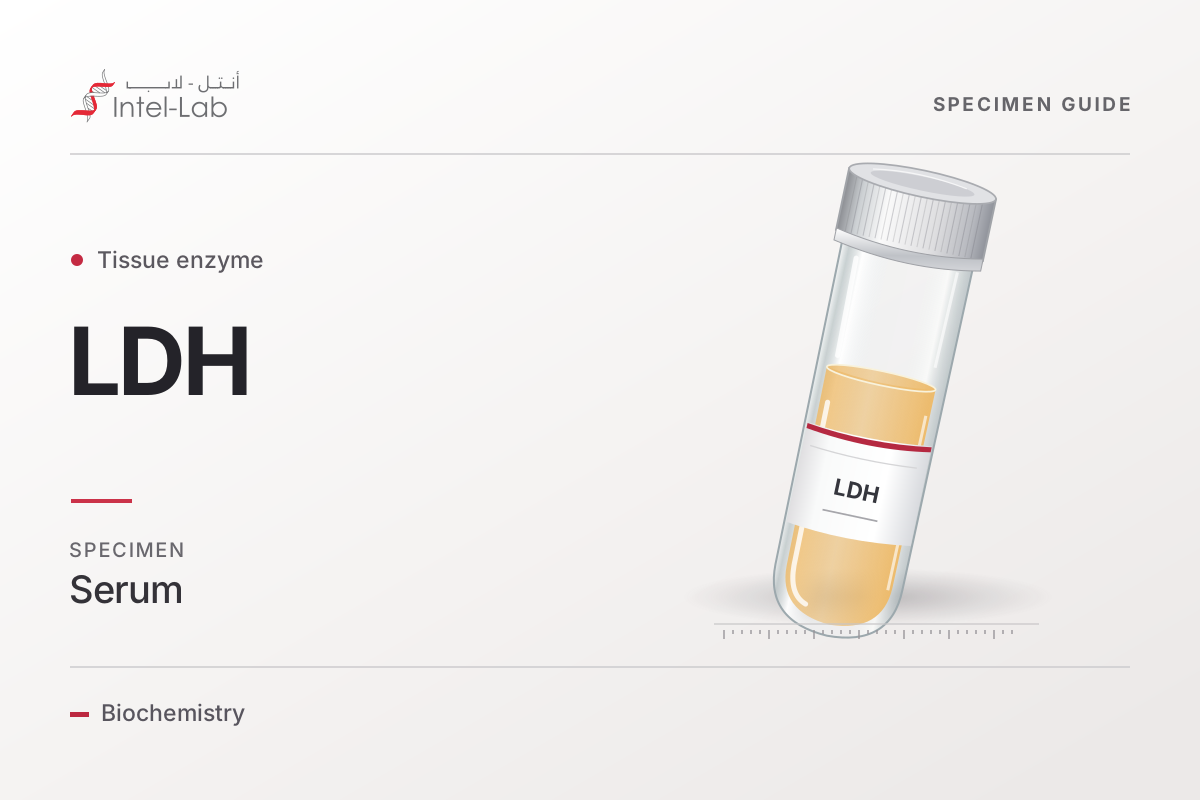
LDH is an enzyme found throughout the body. A change can indicate tissue injury, but the result alone rarely locates the tissue involved.
 Clinical authorDr Nirupama SabhapathySpecialist Clinical Pathology
Understanding the test
Also called Tissue Damage Enzyme
LDH may be used alongside more specific markers when investigating tissue injury or red cell breakdown. Previous values can be helpful in follow-up of a known condition.
LDH may be assessed with bilirubin and reticulocytes when red cells are being lost prematurely.
Serial LDH may add context in selected illnesses when the affected tissue is already known.
Before your sample
No fasting is usually necessary. Avoid unusual heavy lifting or strenuous exercise in the day or two before a planned sample and tell the clinician about an injury.
A clinician takes a small sample of blood from a vein. The laboratory uses serum, the liquid separated from the blood after it clots.
Smart Report
24 hoursLaboratory turnaround
 Result guide
An increase can originate in several tissues. The clinical question and other findings are needed before attaching an organ-specific explanation to it.
From sample to follow-up
Choose your location, add the test to your care bag and select a time. If you are booking for someone else, assign the test to them in checkout.
Choose collection locationLook for Lactate Dehydrogenase (LDH) in your report. Use the sample type and collection time when comparing it with an earlier report.
Explore Smart Report
If LDH is unexpectedly high, ask whether the specimen report mentions haemolysis and which other tests support the finding.
Health packages
Compare the other tests in each package before choosing.
Clinical expertise

Patient questions
Red cells also contain LDH. If some break during collection or handling, the sample can read higher. The laboratory and clinician can assess whether a fresh sample is useful.
A high LDH signals that cells somewhere in the body have been damaged or are turning over quickly, but it does not say where. Red cell breakdown, liver injury, muscle damage from trauma, seizures or intense exercise, tissue infarction, severe infection, pancreatitis and some cancers all raise it. Your doctor uses more targeted tests and your symptoms to find the source.
LDH rises when cells are turning over quickly, so in lymphoma and some other cancers it reflects how active the disease is. It is used mainly to monitor treatment response: a falling value over successive tests supports a response. It does not diagnose lymphoma, and a raised LDH on its own is far more often due to other causes.
KEEP EXPLORING
Open a package to see exactly which tests it includes.

An extensive panel for active individuals, covering inflammation, iron, metabolic, hormonal, thyroid and nutritional status.

Blood count, liver, kidney, cholesterol, blood sugar and urine tests: the essentials in one visit.

A complete blood count with liver enzymes, cholesterol, kidney markers and fasting blood sugar from one blood sample.

A broad whole-body screen covering blood, urine and stool with kidney, liver, lipid, iron, diabetes and vitamin markers.
Choosing for a particular need?
We can help you read the options.
Your next step
Written by Dr Nirupama Sabhapathy, Specialist Clinical Pathology. Medically reviewed by Dr Joyce Jose, Specialist Clinical Pathology, on .
Catalogue information and AED price checked on 2 November 2026. Clinical suitability, preparation, collection arrangements and turnaround are confirmed for your selected test.