Arrange your collection
Choose your location, add the test to your care bag and select a time. If you are booking for someone else, assign the test to them in checkout.
Choose collection location
Biochemistry · Individual laboratory test
Iron studies compare the iron in circulation with the blood's capacity to carry it. The results together help a clinician distinguish different patterns of iron availability.
 Clinical authorDr Nirupama SabhapathySpecialist Clinical Pathology
Understanding the test
Also called Iron, TIBC & Saturation Panel
A group of iron transport measurements can be more informative than serum iron alone when a blood count suggests anaemia or when iron overload is under consideration.
Transport measurements can help the clinician investigate low haemoglobin alongside a blood count.
The percentage of carrying capacity occupied by iron can guide further assessment.
Inside this test
Before your sample
For these transport measurements, a fasting morning sample is preferred. Give the dates of iron infusions or transfusions and agree the timing of any iron tablet with the prescriber.
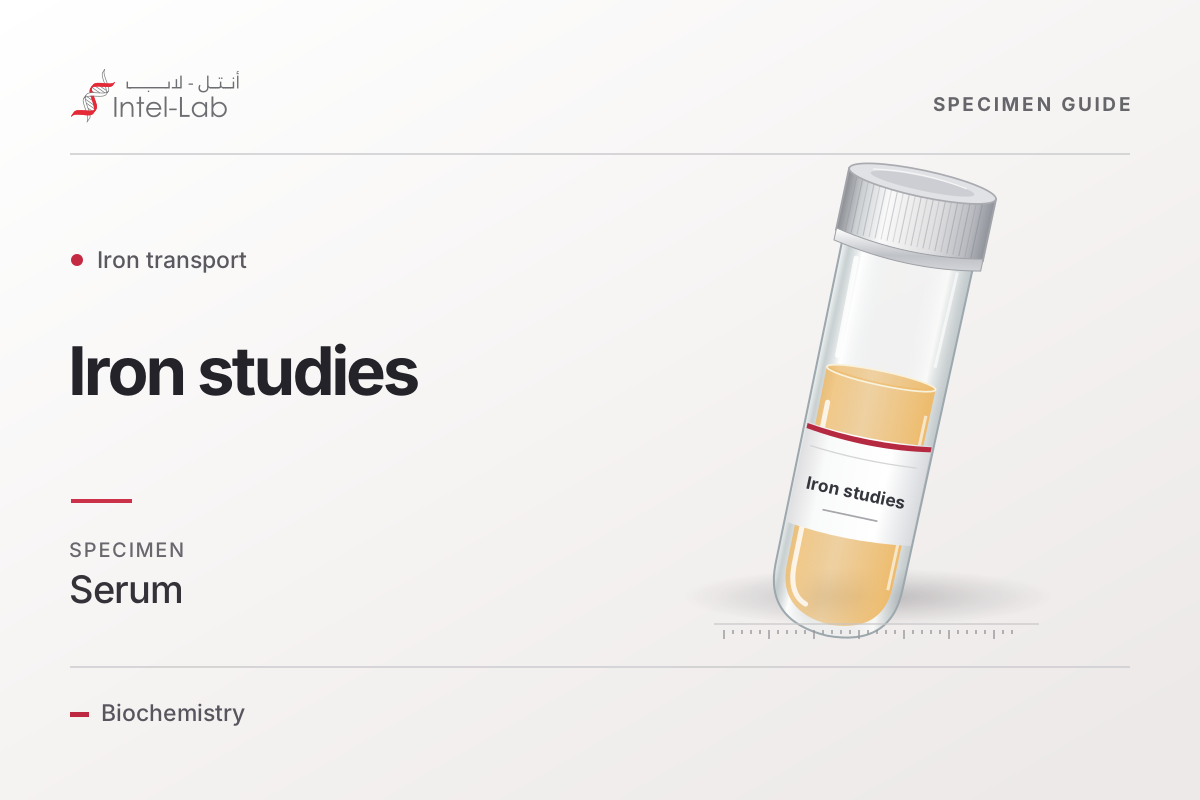
A clinician takes a small sample of blood from a vein. The laboratory uses serum, the liquid separated from the blood after it clots.
Smart Report
24 hoursLaboratory turnaround
 Result guide
The clinician compares circulating iron with the available binding capacity. A storage marker such as ferritin can help interpret the pattern during illness or inflammation.
From sample to follow-up
Choose your location, add the test to your care bag and select a time. If you are booking for someone else, assign the test to them in checkout.
Choose collection locationLook for Iron Studies in your report. Use the sample type and collection time when comparing it with an earlier report.
Explore Smart Report
Ask which part of the pattern changed: circulating iron, available binding capacity or the percentage of sites carrying iron.
Clinical expertise

Patient questions
This panel reports serum iron, total iron-binding capacity and calculated transferrin saturation. Ferritin measures stored iron and is ordered separately. If ferritin is listed on your referral, check that it appears on your test order.
TIBC, total iron binding capacity, measures how much carrier capacity your blood has available to transport iron. A raised TIBC with low serum iron and low saturation is the pattern of true iron deficiency, as the body makes more carrier to capture scarce iron. A normal or reduced TIBC with low iron fits chronic inflammation instead.
High iron and saturation with a low binding capacity raises the possibility of iron overload, such as hereditary haemochromatosis or iron built up from repeated transfusions or long-term iron therapy. Liver disease and conditions with heavy red cell breakdown can also release iron. A supplement dose or infusion shortly before the sample is a common, harmless explanation, so the test is often repeated after proper preparation.
KEEP EXPLORING
Open a package to see exactly which tests it includes.

Serum iron and total iron binding capacity (TIBC) from one blood sample, to check for iron deficiency.
A complete blood count, serum iron and vitamin B12 from one blood sample, to check for anaemia and two of its common causes.

Blood count, liver, kidney, cholesterol, blood sugar and urine tests: the essentials in one visit.
A complete blood count with liver enzymes, cholesterol, kidney markers and fasting blood sugar from one blood sample.
Choosing for a particular need?
We can help you read the options.
Your next step
Written by Dr Nirupama Sabhapathy, Specialist Clinical Pathology. Medically reviewed by Dr Joyce Jose, Specialist Clinical Pathology, on .
Catalogue information and AED price checked on 2 November 2026. Clinical suitability, preparation, collection arrangements and turnaround are confirmed for your selected test.