Arrange your collection
Choose your location, add the test to your care bag and select a time. If you are booking for someone else, assign the test to them in checkout.
Choose collection location
Biochemistry · Individual laboratory test
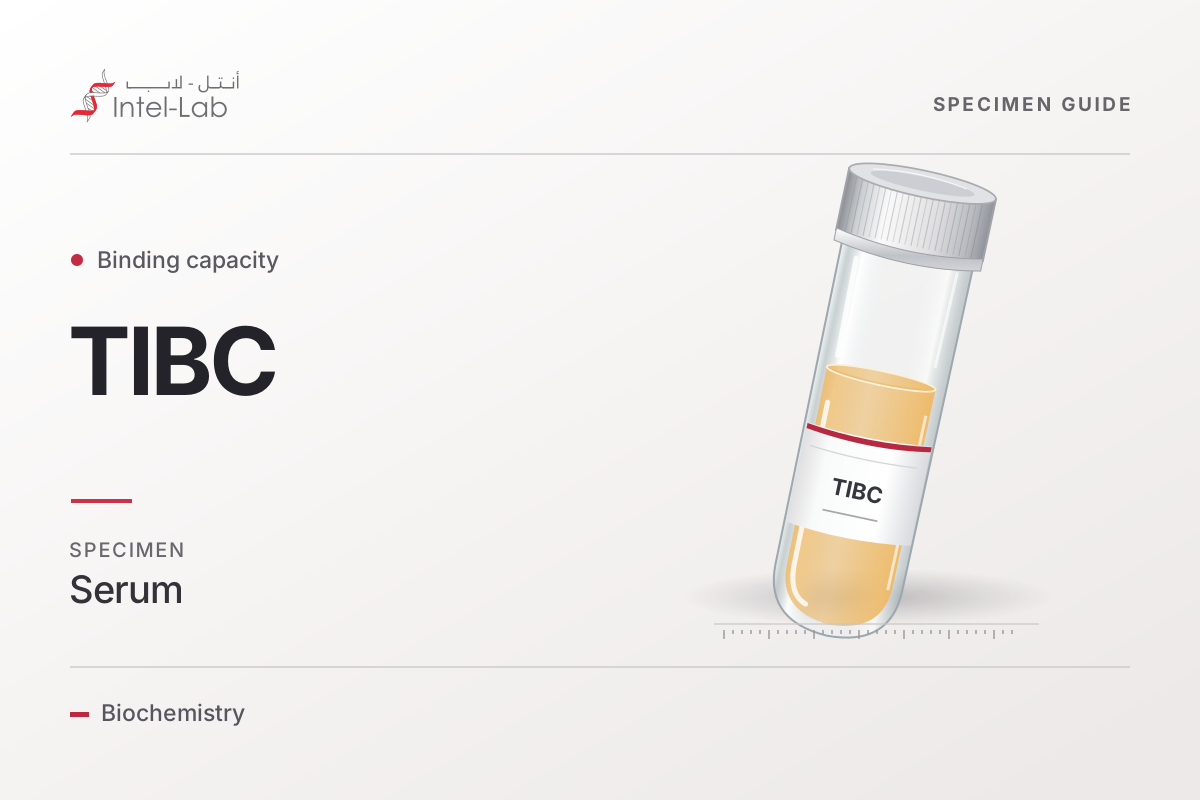
TIBC estimates the total space available for iron on its main transport protein, transferrin. It is often interpreted alongside serum iron.
 Clinical authorDr Nirupama SabhapathySpecialist Clinical Pathology

Understanding the test
Also called Iron Transport Capacity
TIBC can help a clinician investigate anaemia or possible iron overload, particularly when compared with the iron actually present in blood.
Binding capacity may help distinguish iron deficiency from some patterns during chronic illness.
Serum iron and TIBC together show the proportion of binding capacity occupied.
Before your sample
Plan a fasting morning sample, especially when serum iron is measured at the same time. Ask about the timing of iron tablets before the appointment.
A clinician takes a small sample of blood from a vein. The laboratory uses serum, the liquid separated from the blood after it clots.
Smart Report
24 hoursLaboratory turnaround
 Result guide
A high binding capacity can be seen when iron is scarce. Transport protein production and inflammation can also affect the value, so ferritin provides useful additional context.
From sample to follow-up
Choose your location, add the test to your care bag and select a time. If you are booking for someone else, assign the test to them in checkout.
Choose collection locationLook for Total Iron Binding Capacity (TIBC) in your report. Use the sample type and collection time when comparing it with an earlier report.
Explore Smart Report
Compare TIBC with serum iron and ferritin from the same period. Ask whether iron transport or iron stores are driving the result.
Health packages
Compare the other tests in each package before choosing.
Clinical expertise

Patient questions
Saturation describes how much of the available capacity is occupied. It gives context to TIBC when the clinician is investigating low or excess available iron.
TIBC describes how much iron the blood can transport, through transferrin; ferritin reflects how much iron is stored. In classic iron deficiency they move in opposite directions, TIBC up and ferritin down. TIBC cannot replace ferritin as a measure of stores, and inflammation shifts both, so your doctor reads them together with serum iron.
Because the liver responds to scarcity by making more transferrin. More carrier protein means more empty binding sites, so the measured capacity rises even though there is less iron available to fill it.
KEEP EXPLORING
Open a package to see exactly which tests it includes.

Serum iron and total iron binding capacity (TIBC) from one blood sample, to check for iron deficiency.

A broad whole-body screen covering blood, urine and stool with kidney, liver, lipid, iron, diabetes and vitamin markers.

A whole-body screen of blood, urine and stool with kidney, liver, lipid, iron, diabetes and vitamin markers, plus thyroid function and a full…

A focused panel checking the iron, thyroid, hormonal and vitamin markers most commonly linked to hair loss.
Choosing for a particular need?
We can help you read the options.
Your next step
Written by Dr Nirupama Sabhapathy, Specialist Clinical Pathology. Medically reviewed by Dr Joyce Jose, Specialist Clinical Pathology, on .
Catalogue information and AED price checked on 2 November 2026. Clinical suitability, preparation, collection arrangements and turnaround are confirmed for your selected test.